
The social restrictions put in place in Australia to combat the coronavirus have been successful so far, helping to keep the spread of COVID-19 in check by encouraging people to isolate themselves at home.
But what impact have these measures had on our relationships and how have we spent our time under lockdown? Have we locked ourselves away from all kinds of contact and lived like hermits, or have we fully embraced online living?
Anecdotally, when COVID-19 social restrictions were first put in place we quickly got the impression that people were putting more effort into connecting with each other during lockdown than they would do normally. From friendship groups hooking up on Zoom to families making the effort to check in on one another, and even to old flames reconnecting long distance. It felt like the Australian community in lockdown was actually more connected with one another than before.
So WhistleOut surveyed 1,000 Australians to find out what impact the social restrictions have had, and how we've used telecommunications to not only stay in touch, but to stay sane.
Living online
If you feel like you've been glued to your monitor lately, you're not alone. According to our survey 78% of Australians are spending more time online due to coronavirus restrictions, with many spending a staggering five hours or more online every day.
How much additional time we're spending online
| Additional Time | |
|---|---|
| Up to 30 minutes per day | 8.7 |
| Up to 1 hour more per day | 13.5 |
| Up to 2 hours more per day | 16.9 |
| Up to 3 more hours per day | 12 |
| Up to 4 more hours per day | 8.8 |
| 5 or more hours per day | 18.4 |
| No more additional time | 21.7 |
A whopping 18% of Australians say they are now spending at least five additional hours online every day, including both work and leisure time. The younger age groups (18-34 yrs) are spending the most extra time online, with women spending more time online than men.
Where is all this online time being spent?
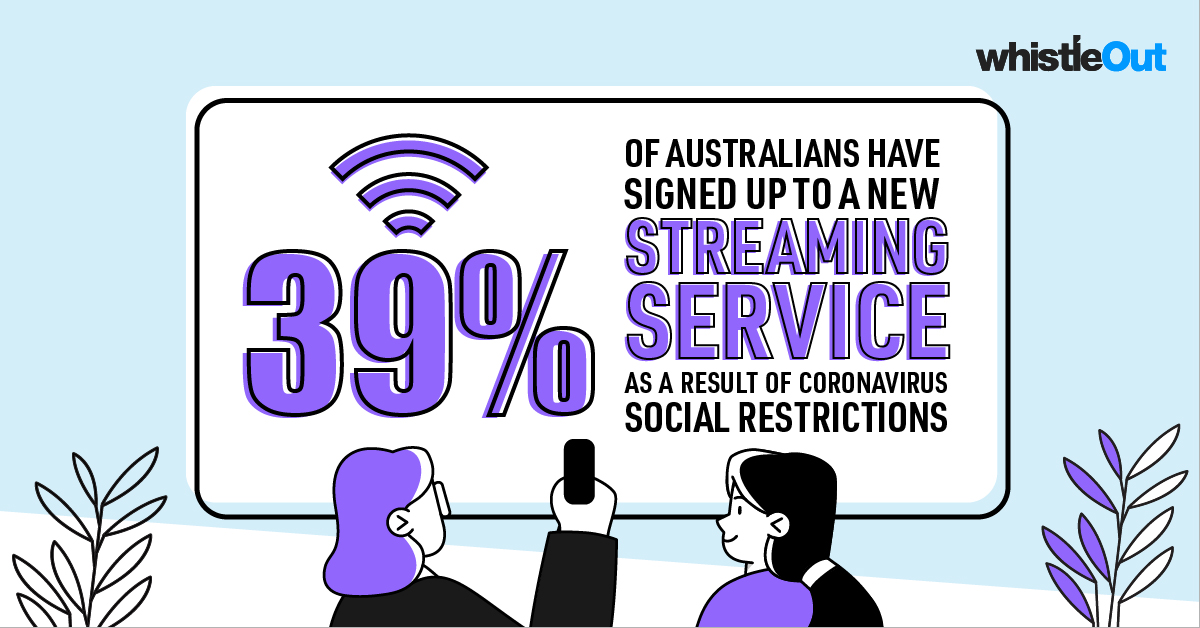
When it comes to spending our time online, streaming services take top billing. Not only have we found streaming services to be the most valuable phone or internet based service or app during coronavirus restrictions, but well over a third of Australians have signed up to a new streaming service while self isolating.
Most valuable online service or app during lockdown
| Service or app | % of people |
|---|---|
| Streaming TV & movie services | 23.7 |
| Video conferencing | 17.6 |
| Social media | 12.1 |
| Instant messaging | 8.4 |
| Text messaging | 7.2 |
| Online shopping | 6.5 |
| Online gaming | 5.7 |
| Making phone calls | 4 |
| Online gambling | 1.2 |
| Dating apps | 0.4 |
| Other | 1.2 |
| None were particularly useful | 12 |
Netflix has been most popular for people subscribing to new streaming services, with 69% of this group signing up to Netflix, 26% signing up to Stan, 25% subscribing to Disney+, 20% to Amazon Prime and 13% to Foxtel Now.
Looking at all of Australia together, 72% of Australians now subscribe to streaming services and, on average, subscribe to at least two different streaming services. Again, Netflix dominates popularity with 63% of Australians holding a Netflix account, while Stan comes in a distant second with 19% of Australians subscribed to it.
Trying something new
People have also been using their additional time online to try new apps and services, with two-thirds of us having tried new things online during the coronavirus social restrictions. Online shopping, personal training and online gaming have been some popular new online activities but video conferencing has been the revalation here, with a massive 42% of Australians having held video catch ups with friends and family for the first time.
New way of using online apps or services
| Activity | % of people |
|---|---|
| Video catch ups with friends & family | 41.9 |
| Online shopping | 26.8 |
| Online gaming | 18.3 |
| Online personal training/yoga | 16.8 |
| Online course (language, cooking, etc) | 13.3 |
| Virtual tours (museums, galleries, zoos, etc) | 8.6 |
| Online gambling | 5.8 |
| Other | 2 |
| No new ways of using online apps or services | 34.8 |
Home internet performance
Thankfully, Australia's internet appears to have held up quite well during the lockdown period. 75% of people have been satisfied with the performance of their home internet, with 42% extremly satisfied. In comparison, only 12% have been dissatisfied with their home internet performance during the coronavirus restrictions.
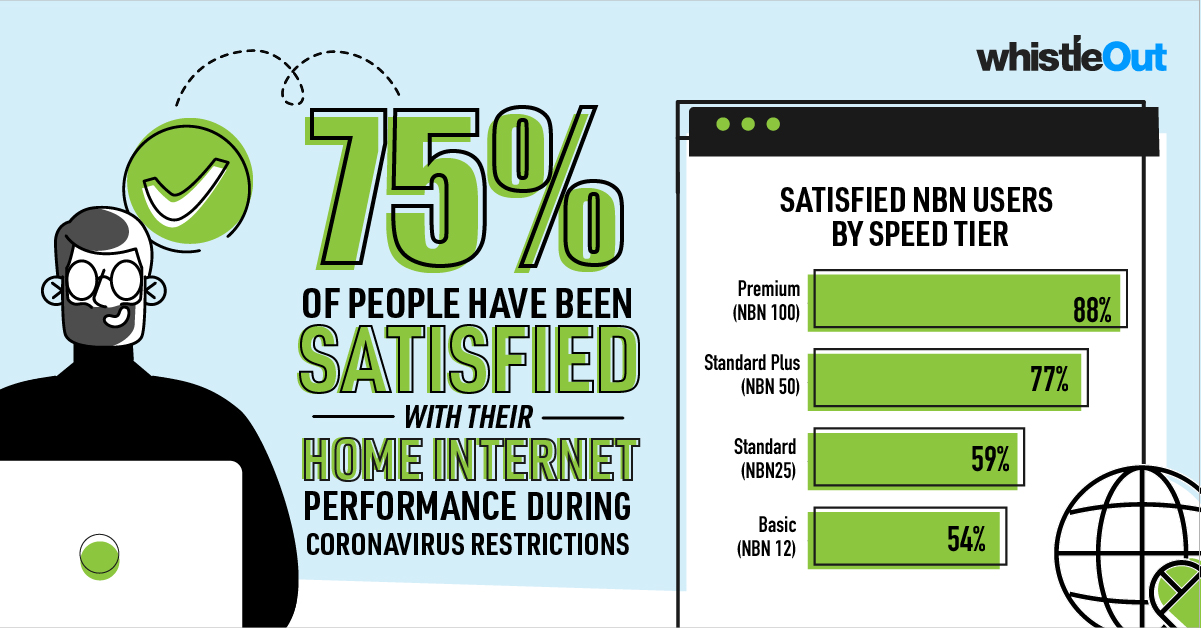
However, there have been large disparities in NBN performance satisfaction depending on which NBN speed tier a person accessed. Those on the fastest Premium speed tier (100Mbps) were clearly the happiest with their service, while performance satisfaction levels fell as speed tiers got slower. It's clear that speed has played a big role in how well we've enjoyed using our home internet.
The survey also showed how little some people know about the internet service they pay for every month:
- Nearly 1-in-5 people (17%) didn't know what type of internet connection they had, and
- Of those with an NBN connection, 1-in-3 (29%) didn't know what speed tier they were on
These two findings were particularly weighted towards females. While 55% of the 1,000 people surveyed were women, 71% of the respondents who didn't know what home internet connection they had were female, as were 67% of the respondents who didn't know their NBN speed tier.
Has all this time online been causing stress?
We wanted to find out whether or not the increased use of online apps & services had caused people to feel additional stress. It turns out it has been a mix of both, but for the majority using online apps and services has helped keep stress levels down.
Online apps & services - causing additional stress or helping to relieve it?
| Impact on stress levels | |
|---|---|
| Causing additional stress | 26 |
| No change | 20 |
| Relieving stress | 54 |
Those who found online apps and services to have helped relieve stress said they'd largely benefited by being able stay connected with loved ones and having distractions to stay occupied and keep their minds off the pandemic.
For those who had felt additional stress due to using online apps and services feelings of loneliness, a lack of human contact and a sense of being overwhelmed by the uncertainty of what was going to happen due to COVID-19 were frequently cited problems.
Isolation has brought people closer together
Interestingly, the survey found that since being resticted by coronavirus isolation measures, Australians have more actively contacted their family and friends.
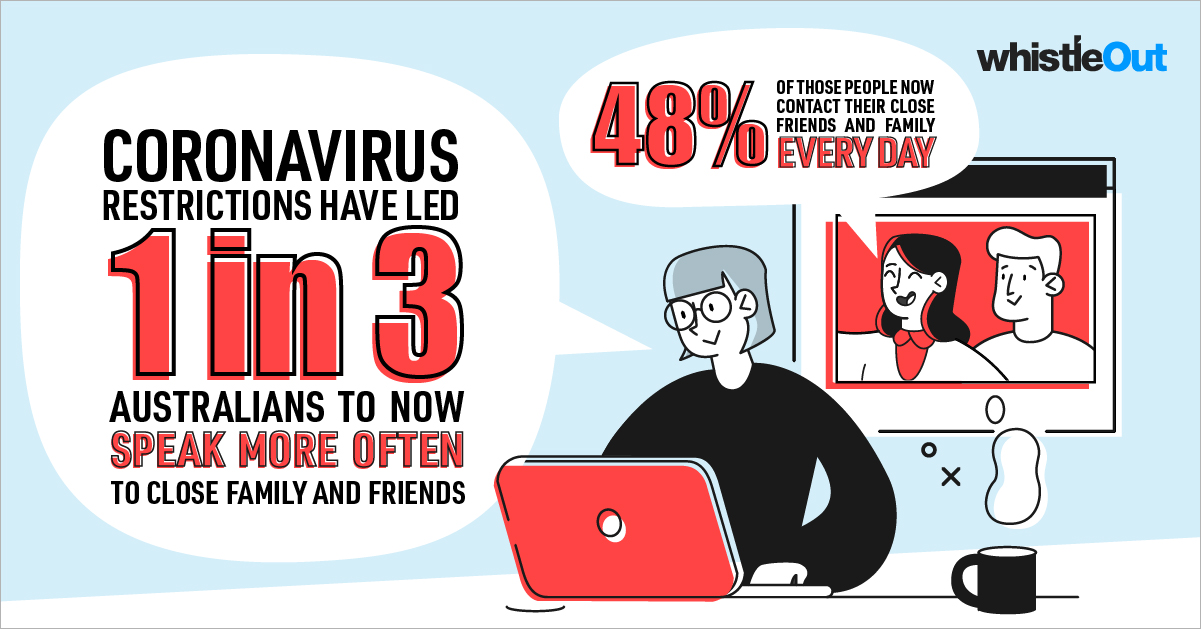
In fact, since the COVID-19 restrictions started 37% of Australians are now in more frequent contact with their close family and friends than they were before. And half (48%) of that group are now in contact with someone in their close family every day.
The increase in people contacting each other more frequently extends beyond close family and friends. 2-in-5 (39%) Australians have initiated contact with people they aren't regularly in touch with, such as old friends, old colleagues and ex-partners:
- 1-in-4 (24%) have contacted others because the virus restrictions have made them realise the importance of friendships
- 1-in-5 (20%) have contacted others because they've felt lonely and wanted to connect with people they've known a long time
- While nearly half (44%) have contacted others to check in on how they were coping with the COVID-19 restrictions.
For many people the lockdown conditions imposed by COVID-19 certainly appear to have been a catalyst to reignite friendships.
Other findings
The survey suggests the coronavirus measures have affected over half (53%) of Australians' normal working operations:
- 18% are now working from home, full time
- 8% are working from home but with less hours
- 15% are working as before but with less hours, while
- 12% say they are now out of work due to the impact of the coronavirus
A number of Australia's telecommunications providers have proactively introduced a range of assistance packages to help their customers navigate the financial difficulties presented by the coronavirus. However, not even half (41%) of Australians are aware of these assistance packages.
Are you aware that telco providers are providing assistance packages?
| Yes | 41 |
| No | 59 |
See all telco assistance packages for more information.
Methodology
The survey was conducted in May 2020 using the survey tool Pollfish. The 1,000 Austrailan respondents were aged 18 years and over, with a 55:45 female to male split.
Kenny McGilvary
PR & Communications Manager | X

Related Articles

![[Editor's Picks] The best NBN plans for October 2026](https://r3.whistleout.com.au/public/images/articles/2026/01/nbn-featured.png?w=160&h=160&usm=20&usmrad=0.8&fit=crop "[Editor's Picks] The best NBN plans for October 2026")


Internet Plans by State
- Internet Plans in ACT
- Internet Plans in NSW
- Internet Plans in NT
- Internet Plans in QLD
- Internet Plans in SA
- Internet Plans in TAS
- Internet Plans in VIC
- Internet Plans in WA


![[Editor's Picks] The best NBN plans for October 2026](https://r3.whistleout.com.au/public/images/articles/2026/01/nbn-featured.png?w=280&h=280&usm=20&usmrad=0.8&fit=crop "[Editor's Picks] The best NBN plans for October 2026")


